What It Feels Like to Never Walk Into an Interview Unprepared
I had thirty minutes with Farhat. That's it. Thirty minutes to find the emotional spine of her story for a short corporate film about leadership development.
I'd already done a pre-production interview with her weeks earlier. I knew the raw material was there. A hostile meeting where colleagues turned on her. A moment of vulnerability in a room full of leaders. A philosophy about building a village that she borrowed from her own life as a single mom. But the first call was too broad. I got interesting answers, not filmable ones. I needed to go back in with a sharper plan.
So before the second call, I did something I'd never done before in my career. I reviewed every conversation from the project, not just hers, but all four pre-production interviews with all three subjects. I looked at where each person's story overlapped, where the gaps were, and what this film still needed. Then I reviewed my planned questions against that picture. Which ones were essential? Which ones were too soft? What was I missing?
By the time I sat down to talk to Farhat, I had ten focused questions, prioritized. I knew exactly what I needed from her and why.
I have never felt that prepared going into a call.
When the conversation actually matches the plan
Here's what surprised me. The call wasn't just productive. It felt effortless.
In previous interviews, I would burn ten minutes circling a topic before landing on the right question. This time I opened with the hardest one. I asked Farhat to bring me into the exact room where things fell apart. She did. Within the first minute, she was describing the Teams call, the hostile colleague, the silence from everyone who should have had her back.
During the conversation, I had coaching suggestions appearing in real time. Normally I'd expect them to be slightly off, the way most AI tools are when the context is nuanced. But they weren't off. They were suggesting questions I had already planned, sometimes before I could ask them. One suggestion landed at exactly the right emotional beat: "After that meeting, who did you actually go to?" That's a question a seasoned producer would whisper in your ear. It arrived at the moment Farhat was describing feeling completely alone.
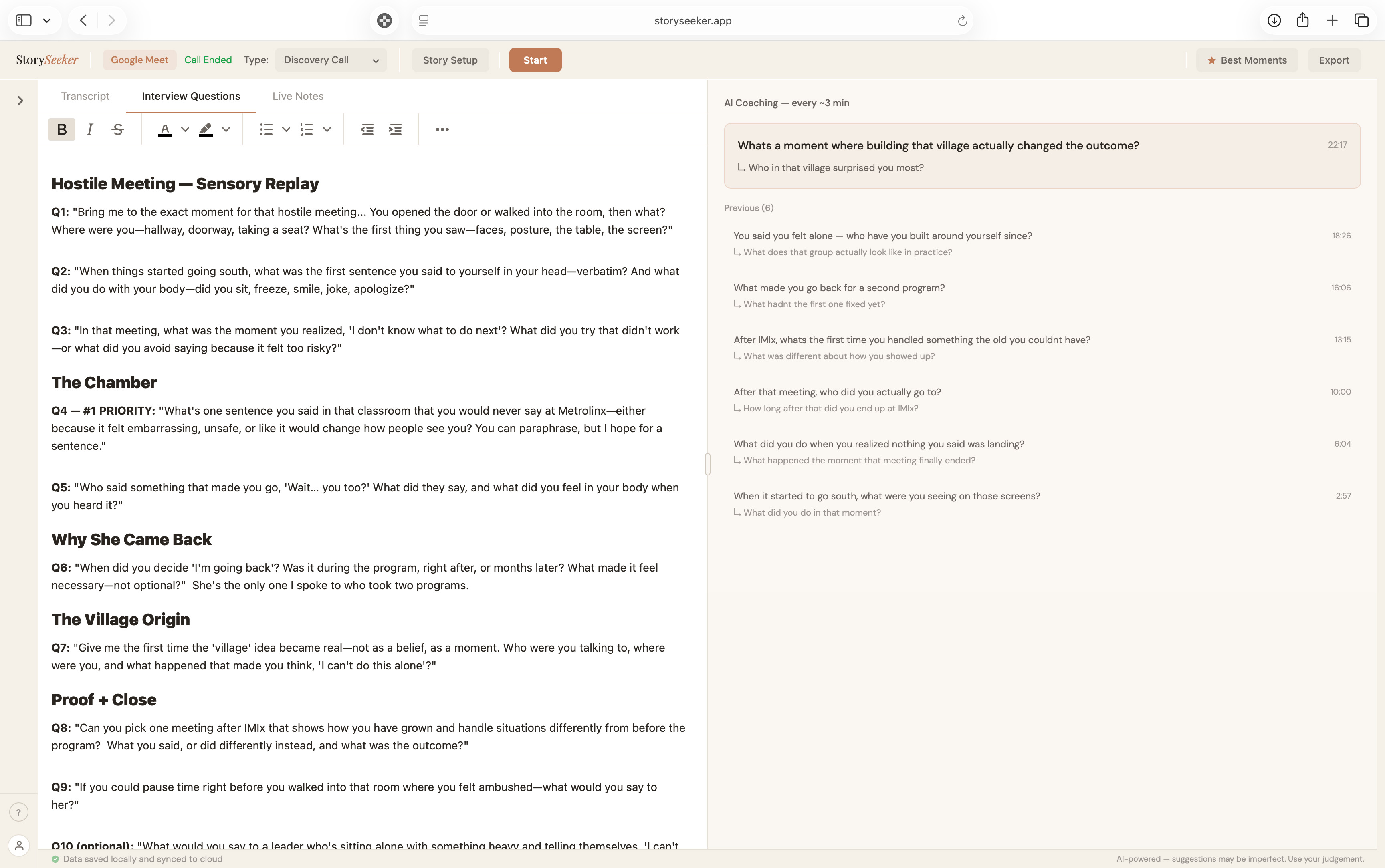
Prepared questions on the left, live coaching suggestions on the right. The suggestions were so in sync they were anticipating my own planned questions.
The result? In twenty-five minutes, I got the hostile meeting in full sensory detail. I got the moment she said the word "hostile" out loud for the first time in a safe space. I got her describing how she's changed the way she communicates since. And I got an unguarded line about being a single mom that reframed her entire philosophy from a corporate strategy into something personal and earned.
With thirty minutes and a sharp plan, I left that call with enough new story angles to fill an hour.
Before, during, and after
When I stepped back and looked at the whole process, something clicked. I'd been supported through the entire arc of this production. Not just the live interview, but the thinking that came before it and the analysis that came after.
Before the call: I could see where my project stood across all subjects, what gaps remained, and exactly what to prioritize. During the call: real-time suggestions that matched the emotional and narrative context of the conversation. After the call: a clear breakdown of what I captured, what's still missing, and what to do next.
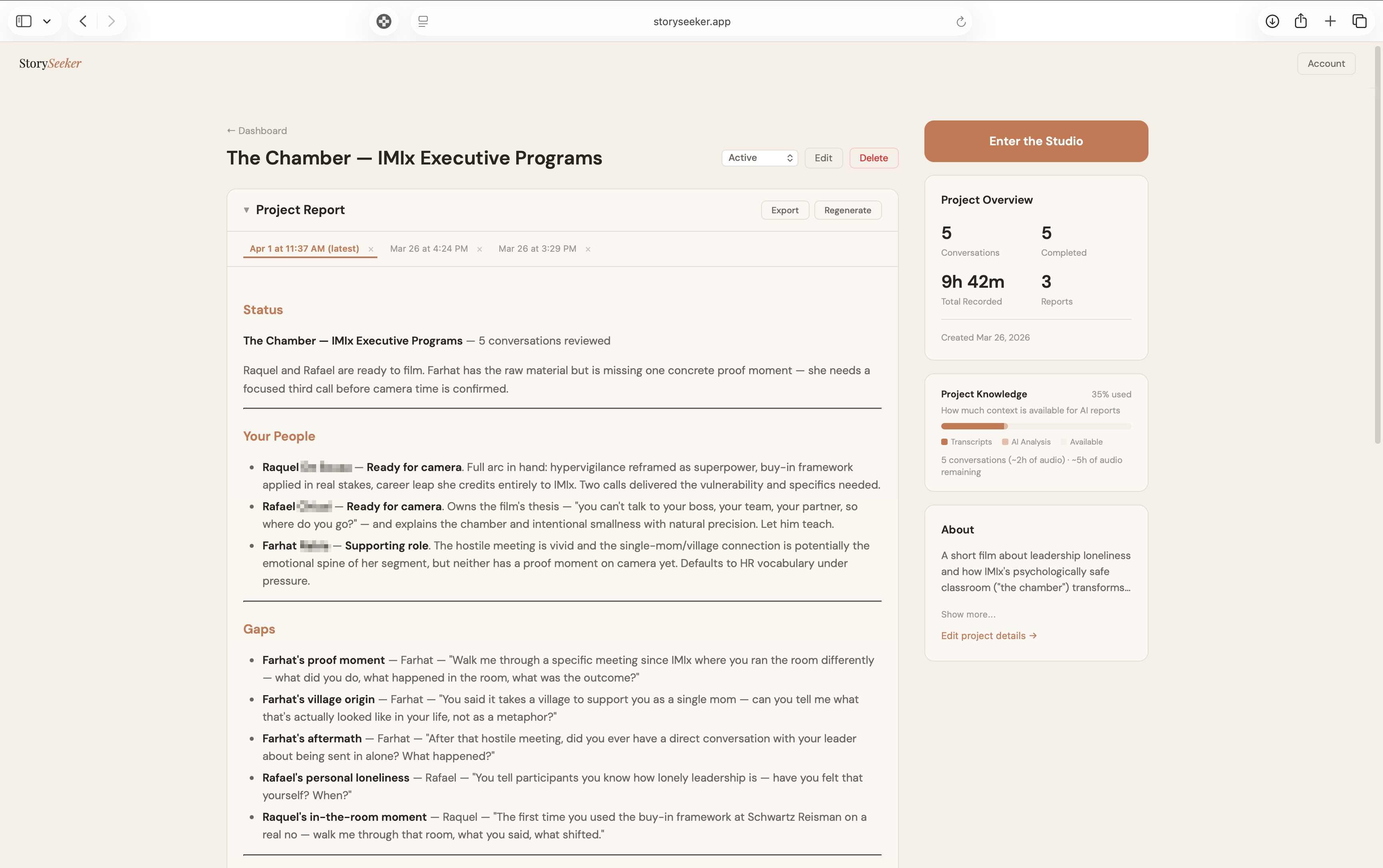
After every conversation, the project report updates. Who's a strong fit, what gaps remain, and exactly what to ask next.
There are plenty of tools that help filmmakers in pre-production. Plenty that help in post. But the live conversation, the part where the story actually surfaces or stays buried, has always been a gap. This was the first time I experienced something that covered the full loop.
That tool is StorySeeker, and as of this week, it's quietly open to the public at storyseeker.app. Free to try, three hours of recording included, no credit card.
The honest version
I won't pretend the launch wasn't nerve-wracking. I care too much about this project to play it cool. It's not perfect. There will be hiccups. But after running my own production through it and seeing the difference in my interviews, my preparation, and my clarity on where each story stands, I know it works. Not because the technology is impressive, but because the interviews got better. The stories got deeper. The moments I used to miss, I caught.
If you've ever sat in an edit suite wishing you'd asked one more question, that's who I built this for.
Ready to uncover deeper stories?
StorySeeker gives you an AI coach in your ear during every interview. 3 hours free, no credit card required.
Get Started Free