The Follow-Up Questions I Didn't Have to Think Of
Twenty-two minutes into my second call with Farhat, I glanced at the right side of the screen. A question was waiting there that I hadn't thought to ask. It was sharper than the one I was about to.
I've been interviewing documentary subjects for years. The hardest part has never been the prepared questions. It's the follow-ups. The ones that have to arrive in the narrow window between what someone just said and the emotional door closing behind it. Miss that window and the moment is gone. You can circle back later, but it won't be the same answer.
On this call, seven follow-up suggestions surfaced while Farhat was talking. Not one of them felt like AI. They felt like a producer who'd been in the room for twenty years.
Here are three of them.
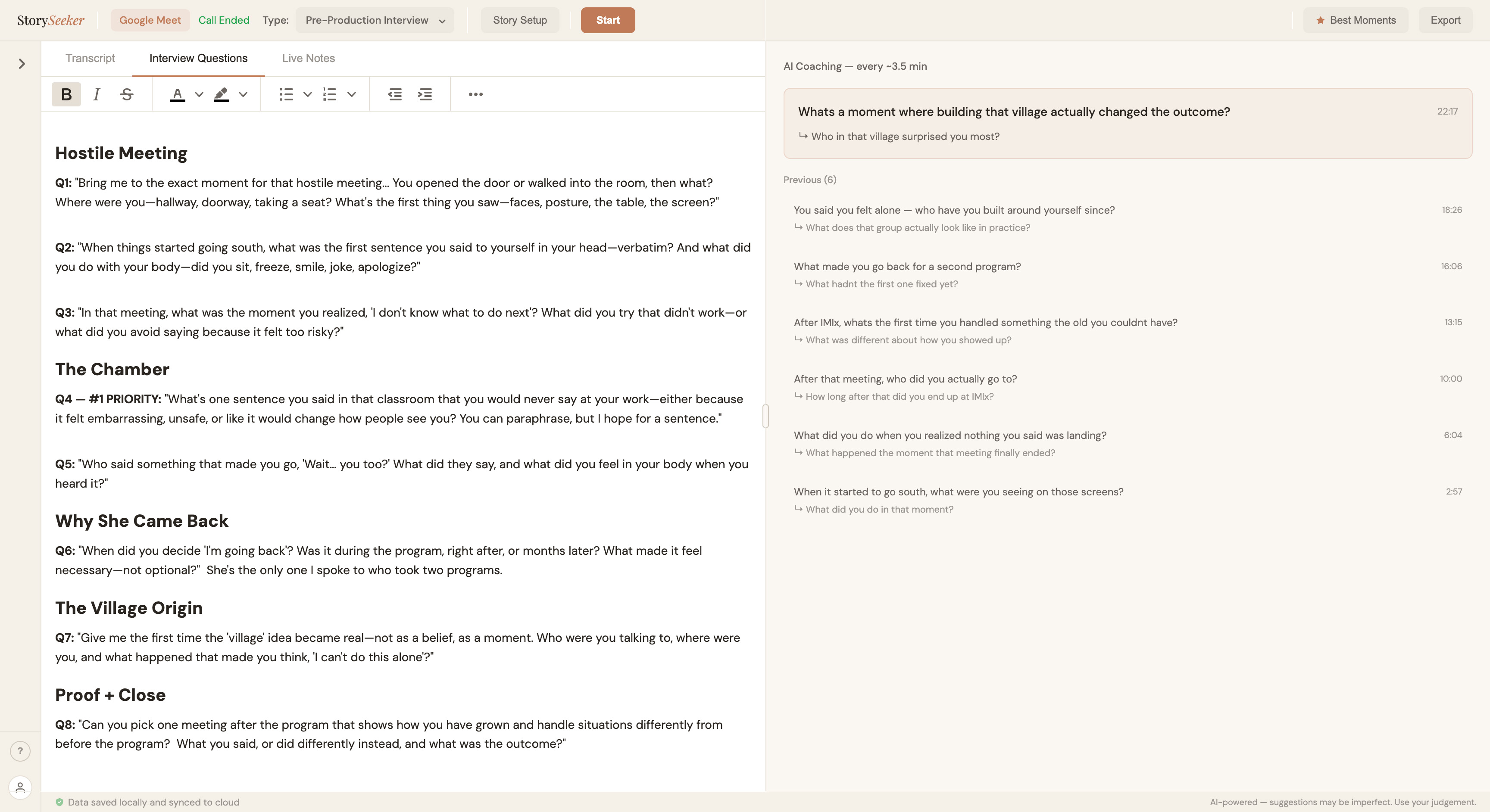
Six follow-up suggestions from a single 25-minute call. This is the column I glanced at when the right question wasn't coming to me.
"After that meeting, who did you actually go to?"
Farhat was ten minutes in, describing the isolation. Eight colleagues on a Teams call, her leader absent, one hostile voice dominating the room. She said the word alone. She said it more than once.
The obvious follow-up is "how did that feel." That's what most of us reach for, and it's almost always the wrong question. It asks the subject to narrate an emotion they've already shown you. What the sidebar offered instead was a question about action. Who did you actually go to. Not how did you cope, not what did you think. Who.
That's a filmmaker's question. It opens a second scene. Suddenly you're not trapped in the boardroom anymore. You're walking out of it with her.
"What did you do when you realized nothing you said was landing?"
This one arrived at minute six, as she was describing the moment she realized she'd lost the room. It does the same thing as the first question, but earlier in the arc. It assumes something most interviewers hedge around. That she knew. That there was a specific moment she registered the collapse and had to decide what to do with her body and voice in the next second.
A surface-level interview would have asked how she felt when it went south. This one asked what she did. Present tense, active verb, narrow window. That's how you get a scene instead of a summary.
"You said you felt alone, who have you built around yourself since?"
This is the one that made me sit up. It appeared at minute eighteen, right after Farhat said she felt alone in the chamber, that safe space she'd found months later.
What the suggestion does is bridge her past and present in a single sentence. It takes the wound she just described and invites her into the after. Not "how did you recover." Who have you built. Active, concrete, assumes agency on her part. It turns a moment of vulnerability into the setup for a story about her village.
She didn't answer it in that exact shape. But it pointed me toward the thread, and I followed it. That thread turned out to be the spine of her whole segment.
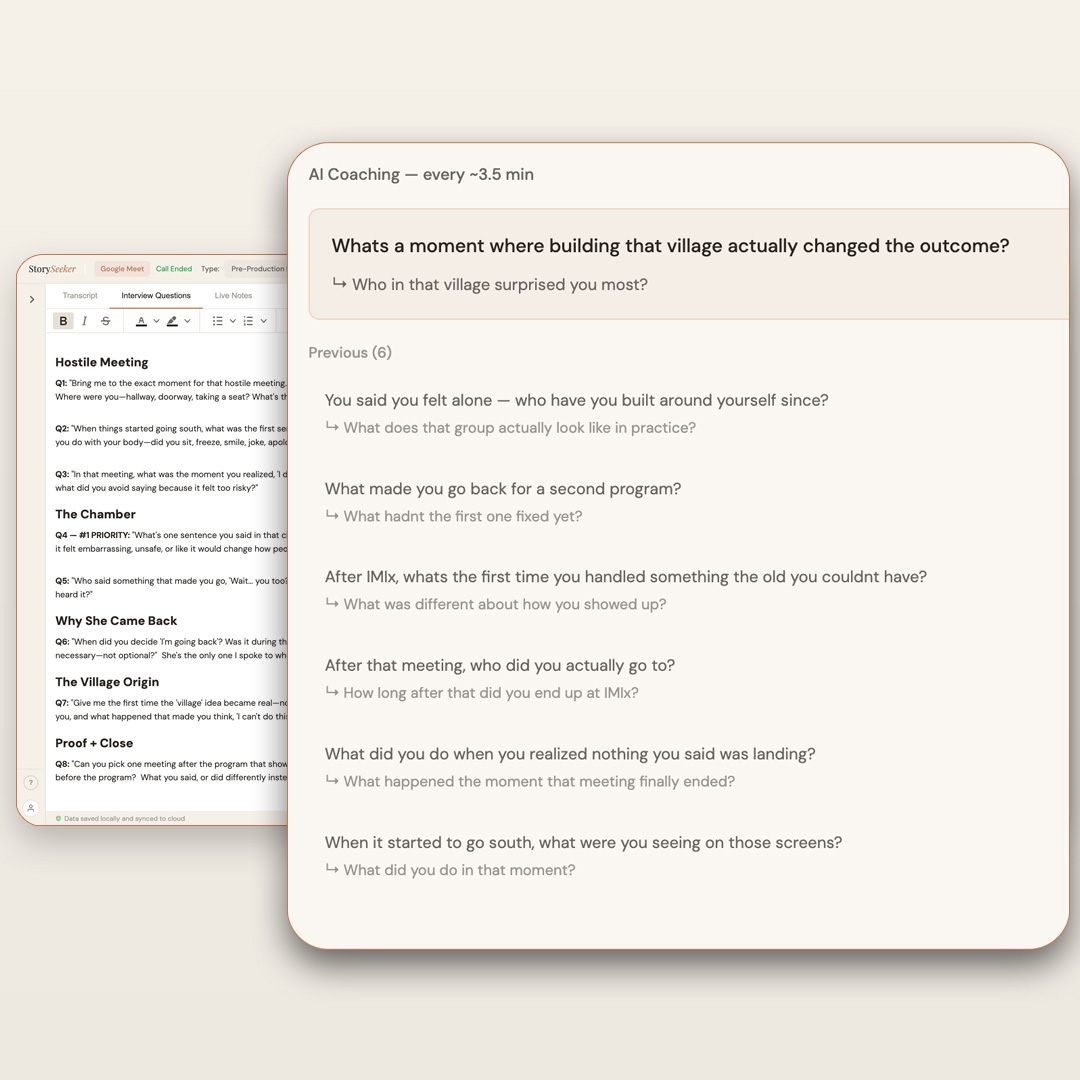
This suggestion arrived about fifteen seconds after Farhat said the word alone. That's the window a follow-up has to land in.
What makes a whispered question good
The pattern, once I saw it, was simple. The best suggestions were concrete instead of abstract. They asked what someone did, not how they felt. They were time-bound to a specific moment, not a general arc. They assumed the subject had agency in the scene, even when the scene was painful.
That's the whole craft of follow-ups, compressed into a right-hand sidebar.
I'm not going to pretend I would have missed all six of these. I would have asked maybe half of them eventually, on a good day, with a cup of coffee in me. What changed is that I didn't have to. I could stay in Farhat's face. I could listen to her voice change. The questions were waiting when I needed them.
StorySeeker is the tool that was holding them for me. Free to try, three hours of recording included.
Ready to uncover deeper stories?
StorySeeker gives you an AI coach in your ear during every interview. 3 hours free, no credit card required.
Get Started Free